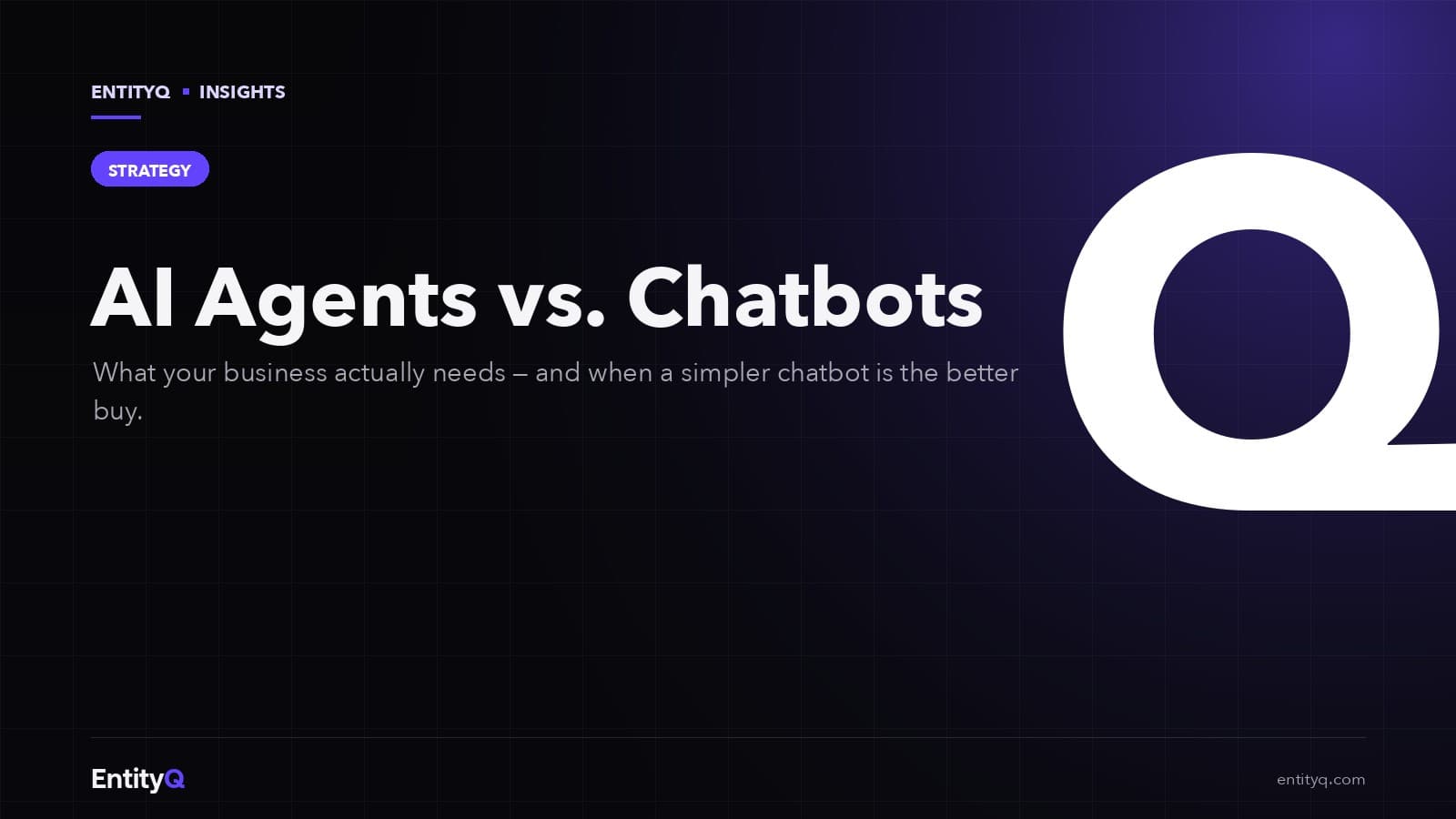
AI Agents vs. Chatbots: What Your Business Actually Needs
Chatbots and AI agents are not the same thing. This comparison explains what each does well, where the costs differ, and how to choose without overbuilding.
EntityQ Team
AI agent development
The short answer: a chatbot is built to talk. An AI agent is built to do.
A chatbot can answer a question, qualify a visitor, or route a conversation. An AI agent can look up an order, update a CRM, send a document, schedule a meeting, or complete a multi-step process across several systems. The right choice depends on what happens after the conversation starts.
What a chatbot does well
Chatbots are a strong fit when the job is mostly communication:
- Answering common questions about hours, pricing, policies, or services
- Qualifying visitors and collecting contact details
- Routing people to the right page, team, or human
- Providing 24/7 first-line support for a known set of topics
A good chatbot is fast, predictable, and cheap to operate. It is also easy to scope. If the answer already exists on your website, a chatbot can surface it without a complex integration.
What an AI agent adds
An AI agent adds three things a chatbot usually lacks:
- Tools. The ability to call APIs and act in your systems.
- Planning. The ability to choose a sequence of steps instead of following one script.
- Verification. The ability to check whether an action worked and recover if it did not.
That is why agents are a better fit for work like: "Find this customer's order, confirm the delivery date, and email them an update." A chatbot can explain the policy. An agent can complete the task.
Side by side
| Chatbot | AI agent | |
|---|---|---|
| Main output | A reply | A completed task |
| Scope | Conversation | Conversation plus actions |
| Systems access | Limited or read-only | Read and write through tools |
| Complexity | Lower | Higher |
| Risk | Mostly reputational | Operational — it can change records, send emails, or move money |
| Best for | FAQ, lead capture, routing | Multi-step workflows that need judgment |
When a chatbot is enough
Do not build an agent just because it is the newer idea. A chatbot is often the better first project when:
- Most requests are informational.
- The workflow ends when the conversation ends.
- You do not have API access to the systems that would need to change.
- The cost of a wrong action is high and the volume is not high enough to justify the controls.
- You need something live quickly and can expand later.
A chatbot that answers well and routes cleanly can deliver real value. It is also a low-risk way to learn how your customers actually ask for help.
When an agent is worth it
An agent starts to make sense when the conversation is only the beginning. Common signals:
- Your team copies information between tools after every call or email.
- Customers ask for the same multi-step outcome, but the path varies.
- The work is high volume and the rules are clear enough to test.
- You have APIs or structured data the agent can use.
- You can define what "done" looks like and measure it.
If the process crosses three or more systems and involves a decision at each step, an agent is usually the more natural fit.
The middle ground most businesses actually need
In practice, the best solution is often a hybrid:
- A chatbot handles the first interaction and collects context.
- The agent performs the back-office steps.
- A human approves the consequential action.
- The system logs everything for review.
This gives you the speed of automation without handing full authority to a model. It is also easier to launch: you can start with the agent doing preparation work and add autonomy as trust grows.
Four questions to decide
- Does the job end with an answer or an action? If it ends with an answer, start with a chatbot. If it ends with a change in a system, you need an agent or a workflow automation.
- Do you have access to the tools? No APIs, no agent. A chatbot may still be useful.
- What happens if it is wrong? If a mistake is reversible and low-cost, you can move faster. If not, design approvals and limits first.
- Can you measure success? Pick one metric before you build: resolution time, manual touches, conversion, or cost per task.
A note on cost
Chatbots are usually cheaper to build because they have fewer integrations and less testing. Agents cost more because they touch real systems, need permissions, and require monitoring. The larger cost is rarely the model. It is the integration, testing, and ongoing ownership.
If budget is the constraint, start with a narrow agent that handles one high-value workflow and expands later. Our guide to AI agent costs breaks down the drivers.
Frequently asked questions
Can a chatbot become an AI agent?
Yes. Many teams start with a chatbot and add tools, memory, and planning over time. The important thing is to add capabilities deliberately, with guardrails and testing, rather than granting broad access at once.
Are AI agents more expensive than chatbots?
Usually, yes. Agents require more integrations, testing, permissions, and monitoring. The model itself is often a small part of the total cost.
Which is better for customer support?
A chatbot can handle FAQs and routing. An agent is better when support requires looking up orders, processing returns, or changing account details. Many support teams use both.
Need help choosing?
We build both, and we will tell you if a simpler chatbot or a standard automation is the better investment. Book a free AI strategy call or see our AI agent development service.
Frequently asked questions
Can a chatbot become an AI agent?
Yes. Many teams start with a chatbot and add tools, memory, and planning over time. Add capabilities deliberately, with guardrails and testing, rather than granting broad access at once.
Are AI agents more expensive than chatbots?
Usually, yes. Agents require more integrations, testing, permissions, and monitoring. The model itself is often a small part of the total cost.
Which is better for customer support?
A chatbot can handle FAQs and routing. An agent is better when support requires looking up orders, processing returns, or changing account details. Many support teams use both.
Work with EntityQ
Have a workflow that should not be manual anymore?
We design and build AI agents, AI-powered applications, and workflow automation for growing businesses.
Book a free AI strategy call